Ibanez
Ok, I admit, I love Ibanez effects. Or let's put it different, I highly respect the Maxon design team which was behind many of their effects. These guys got up with some brilliant ideas. (And did some evident borrowing from MXR and EHX just as well.)
Some of these, in various cosmetics, have been around for many years. The only problem is that Ibanez (or Hoshino) is definitely a sales company, resulting in various
choices which were definitely not driven from a music perspective. One that comes to mind is the first series of Soundtanks in a metal (yes indeed) casing. More sturdy* than the plastic and making them unique in styling.
* Sturdy?! One can critisize Soundtanks a lot for that cheap plastic casing but I have never ever seen a soundtank with a broken case.
Ibanez/Maxon pedals are extremely "discovered" by vintage effect hunters making them not the choice to collect anymore. I've got a few niner's among which my beloved ST-9 (Dirt cheap as someone in a musicstore forgot to do his homework)(BTW, they must have read this as I never saw them made a similar error after this one).
I didn't have any plans in getting this series into a "complete" status as that requires an OD-9 which are extremely hard to find. The fact that I did find one at a relatively "dirt cheap" changed this. No hurry. All that would be needed
for this collection comes by pretty frequently. Prices are another thing. Especially pedals like the AF-9 are still more players than collectors and therefore usually make good prices as the audience in the bidding pool is larger.
The same was the case for the AFL on which I was outbid (or better, outsniped) on multiple occasions before finally getting one.
It seems to me that over the last two years even classic bargain pedals like to Soundtanks start to get some collectors attention and, therefore, finally get the recognition they deserve as unique (yeah I know, dodgy as they are) designs.
Master Series:
Metal Screamer MSLSuper Metal SML
Super Tube STL
Compressor/Limiter CPL
Analog Delay ADL
Flanger FLL
Graphic EQ GEL
Digital Modulation Delay DML
Digital Chorus DCL
Digital Flanger DFL
Digital Delay DDL
Bi-Mode Chorus BCL
Stereo Chorus CSL
Dual Chorus CCL
Bi-Mode Phaser BPL
Parametric Equalizer PQL
Auto Filter AFL
Power Series:
Tube Screamer Classic TS-10Metal Charger MS-10
Digital Chorus DSC-10
LA Metal LM-7
Fat Cat Distortion FC-10
Mostortion MT-10
Delay III DDL-20
Distortion Charger DS-10
Digital Chorus/Flanger DCF-10
Chorus SC-10
Bass Chorus BC-10
Graphic Equalizer GE-10
Pan Delay DPL-10
Swell Flanger SF-10
Bass Equalizer BE-10
Twin Cam Chorus TC-10
Noise Buster NB-10
Prime Dual Chorus PC-10
Modulation Delay II DML-10
Session Man II SS-20
Octave OT10
Delay II DDL-10
9-Series:
Tube Screamer TS-9Stereo Chorus CS-9
Parametric Equalizer PQ-9
Super Tube Screamer ST-9
Phaser PT-9
Compressor CP-9
Bi-Mode Chorus BC-9
Overdrive OD-9
Analog Delay AD-9
Super Metal SM-9
Sonic Distortion SD-9
Flanger FL-9
Graphic Equalizer GE-9
Auto Filter GE-9
Multi effect UE-300
DCP Series:
Delay PDD1Distortion PDS1
Modulation Delay PDM1
Parametric Equalizer PPE1
Overdrive/Distortion POD1
MIDI Interface DMI4
5-Series:
Background info on metal case SoundtanksClassic Metal CM-5
60's Fuzz SF-5
Powerlead PL-5
CrunchyRhythm CR-5
ThrashMetal TM-5
ModernFusion MF-5
Tube Screamer TS-5
Cyberdrive CD-5
Echo Machine EM-5
Delay DL-5
Compressor CP-5
Chorus CS-5
Black Noise BN-5
Auto Wah AW-5
Flanger FL-5
Bass Compressor BL-5
Tremolo TL-5
0-Series:
Compressor II CP-835Chorus CS-505
Flanger FL301-DX
Phaser Phasetone PT-909
7 (tonelock)-Series:
Tube Screamer TS-7CDelay/Echo DE-7C
Smash Box SM7
Chorus Flanger CF7
Multi and rack effects:
Multi effect UE-400Multi effect UE-405
Digital Delay DM500
Multi effect UE-300
Neo-Classic series:
Tube King TK-999Tube King Compressor TC-999
Analog Delay AD-99
Classic Flange FL-99
Classic Phase PH-99
Rotary Chorus RC-99
Other:
PhaseTone PT-1000PhaseTone II/PT707
Flanger FL-303
Standard Wau Wau
Graphic Equalizer GE-100
Graphic Equalizer GE-1000
Tube King TK-999HT
Metal Screamer MSL

|
This is most likely to be THE most common pedal to be forgotten when listing the various models
of tubescreamers made over the years. While a pedal like the Super Tube STL will be listed among these that pedal
has a lot more differences than the Metal Screamer. Taking a look at the circuit design shows that the low end frequency
response is slightly boosted. Furthermore when the circuit is in bypass the signal going to the overdrive stage will be muted.
Looking at the PCB design of my Tube Screamer Classic TS10 the layout has some minor changes compared to the Metal Screamer MSL while the same
drill pattern is used for the computer automated drill process of the holes on the PCB. The only difference between a Tube Screamer Classic TS-10 are therefore that the frequency
respose is back to the Tube Screamer TS-9, TS-808 design and the muting circuit is gone.
|
Super Metal SML

|
The Super Metal is the successor of the SM-9. As I do not have an SM-9 (yet) I have not verified this in full details but if any, these will be small. The followup of the Super Metal SML is the Metal Charger MS-10 in the 10-series which has exactly the same PCB. Most likely marketing was an issue (again) for this change.Another pedal which shares this design is the Distortion PDS-1 distortion from the DCP series. The difference here is that the rotary controls are replaced here by a chip which contains these (analog !!) controls but gives the advantage of programmability. |
Super Tube STL

|
The Supertube STL, a spinoff from the (rare) Super Tube Screamer ST-9 is based in the design of the tubescreamer with a changed tone control circuit. The result is a slightly more coarse sound. This pedal is by far one of my favourites ever. |
Compressor CPL

|
A compressor limiter. Later the pedal was re-released as the CP-10 compressor in the 10-series. Circuitwise the CPL and therefore the CP10 are similar to the CP-9 except for the VCA used. In the CP-9 half of a LM13600 OTA was used. In the CPL this OTA was replaced by a BA6110 SIL chip. |
Analog Delay ADL

|
An analog delay based on an MN3205 BBD. This pedal followed the AD-9. Therefore it's interesting to check how much
they resemble.... and that differs. I've seen 2 versions of the AD-9 which do differ in some components among which
the filtering. In the end I drew up the AD-9 schematic largely by tracing along the schematic of a CD10 delay champ.
|
Flanger FLL

|
An analog flanger based on an MN3207 BBD. I suspect this pedal to be a close to exact copy of the FL-9 from the 9-series. The FLL was reissued in the form of the SF10 Swell Flanger which uses the sam printed circuit board. |
Graphic EQ GEL

|
Graphic Equalizer. Re-released as the GE-10 Equalizer in the 10-series. |
Digital Modulation Delay DML

|
No description yet |
Digital Chorus DCL

|
No description yet |
Digital Flanger DFL

|
Anyone more to add than that Tom Morello (Rage Against the Machine) (used to) own(s) one??
|
Auto Filter AFL

|
No description yet |
Bi-Mode Chorus BCL

|
Dual rate and depth control on this Chorus. This pedal was re-released as the Twin-Cam Chorus in the 10-series.
|
Digital Delay DDL

|
No description yet |
Stereo Chorus CSL

|
No description yet |
Dual Chorus CCL

|
No description yet. |
Bi-Mode Phaser BPL

|
No description yet. |
Parametric Equalizer PQL

|
Pertty close to the PQ-9 parameetric EQ. This one was the last parametric EQ made by Ibanez. |
Tube Screamer Classic TS-10

|
Another reincarnation of all those tubescramers. This one is slightly different from the Metalscreamer in PCB layout but the same
drill pattern was used. This resulted in some empty holes in the PCB. Amazingly the TS10 finally starts to develop some vintage value as the prices
seem to increase last year. Soundwise it's just another tubescreamer. Don't believe all those stories about these tonal differences with other TS-es. If there
are slight differences this is more due to component tolerances than anything else. If you can hear em congrats. I seriously doubt if you still can when you're
onstage and your drummer is using his cymbals...
|
Distortion Charger DS-10

|
No description yet |
Metal Charger MS-10

|
One of the most creative designs from the Maxon Guys. Started off as the SM-9, later as the SML Super Metal and eventually in this design. Too bad that when Ibanez changed over to the 5-series Soundtanks they were bound by the 3 knob constraints. I guess that even in a Soundtank case this would be an incredibly popular pedal. The metal charger, as well as it's predesessors, have one problem. The distorted sound doesn't come above unity gain making it easily drowning in the rest of the mix. Modification for this is easy and recommended. Instant Metal in a pedal. |
Digital Chorus DSC-10

|
Nice idea that didn't work out that well. The DSC is quite a clean chorus and the warmth control doesn't make it any better. Get a DCL instead. Clean chorus without the hassle. |
Chorus SC-10

|
Higly underrated chorus. Could be considered a poor man's RC-99. |
LA Metal LM-7

|
An oddity it it's type number as it's part of the 10 series and is numbered with a 7. I still have no clue what
this thing has to do with LA, let alone with metal. Bad sounding crap. However I still do like the cosmetics
as this one is suddenly housed in a solid steel case instead of the common aluminum.
|
Fat Cat Distortion FC-10

|
There's claims that this pedal had to be the Ibanez answer to the always and ever popular ProCo Rat. Looking at the schematic suggests the same as they are indeed very similar. I had to have it for looks and name alone already. Fat Cat and subtle don't go together. And by the way, I've seen these advertised multiple times as a tubescreamer on steroids. Nothing is further from the truth. The only thing these two have in common is that they're both pedals and have 3 knobs. |
Mostortion MT-10

|
Someone once called this thing the best Tubescreamer ever. Personally I have to disagree since it doesn't have anything in common with a TS.... other than that it DOES sound very Tubescreamerish. The Mostortion should definitely get more recognition as it is an amazingly great pedal and very versatile. |
Delay III DDL20

|
No description yet |
Digital Chorus/Flanger DCF-10

|
One of these gottahaves!!! Instant Steve Kahn in a box! When you see one, get it! |
Bass Chorus BC-10

|
Bass brother of the SC10. Although labelled different the SC-10 and the BC-10 have the same layout for the printed circuit board. Difference is in the silkscreening and the PCB coating only. Other than altered filter values for the BC10 it seems that the BC10 is missing it's de-emphasis filtering completely. |
Graphic Equalizer GE-10

|
Pan Delay DPL-10

|
Swell Flanger SF-10

|
Continuation of the FLL in a newer style jacket. I have to verify this one but expect it to be an exact copy of the FL-9. |
Bass Equalizer BE-10

|
Twin Cam Chorus TC-10

|
Identical to the BCL.
|
Noise Buster NB-10

|
Clear followup of the National Semiconductor Application note for the LM1849N chip, combined with bypass
circuitry in classic Maxon style dimensioning.
|
Prime Dual Chorus PC-10

|
Full clone of the CCL Dual Chorus |
Modulation Delay II DML-10

|
Alsways nice to buy a pedal which you serviced it once. |
Session Man II SS-20

|
Quite disappointing delay section which is way too short. |
Delay II DDL-10
|
|
Another one of those delay that are often cherised by their owners for the quality of the delays but for some reason never really get the recognition they deserve by a larger audience. Even for their age, these delays are quality stuff, well built, great sounding. |
Octave OT-10
|
|
The one and only attempt ever sold by Ibanez for a octaver pedal. These come quite rare so I felt lucky
finding a rather affordable broken one. The labelling for the edge control seems quite odd when analysing the circuit and
,when looking up online reviews of this pedal, makes the edge control quite misunderstood. The edge control is the level control of a piece
of circuitry that is pretty identical to the octave up section that can be found on an EH microsynth. Therefore, while rolling that guitar volume
a little back as is commmon practice with octave fuzzes one will get a neat, "around the 12th fret", upper octave. That means it's not some odd
tone control that gives something like "industrial harshness" to the sound. A similar implementation can be found in the Pearl OC08 octaver.
|
Tube Screamer TS-9

|
No description needed. A classic. Don't believe the stories about that TS808 conversion and the soundwise miracles that will happen. However, if yours happens to have that Toshiba TA75558 chip get it out and get the 4558 back in. That does make a difference. Bear in mind that anything over 50 cents paid for the chip is overpaid. They're still in production and NOS is pure mojo. If you want a real improvement get it modded to one of the more gain like mods like Keeley's. There's several to be found on the web as well. Tubescreamers are really cool when they're on steroids. |
Stereo Chorus CS-9

|
Jawn Jawn. Just get one and never get rid of it again. Highly lovingable chorus. Nice detail for almost all Ibanzez chorussus is that the wet chorus signal is gated and will be muted if signal is absent at the input, causing the thing to be more silent when not playing. |
Parametric Equalizer PQ-9

|
No description yet. |
Super Tube Screamer ST-9

|
One of my prides since this unit is so extremely hard to find. While seeing one go on Ebay for
some 220 Euro's I picked this fella up as a bargain at a local music store.The basic design
is in fact a tubescreamer with an added "bite" control and a changed cutoff frequency for
the "tone" as found on the normal TS. "The bite" gives a fixed 8dB gain in the mid
frequencies and can be adjusted for a center frequency ranging from 200 Hertz to 2 Khz.
In its mid position the boost is at 300 Hz. The successor of the ST-9 was the STL. Striking difference
between the 2 is that the mid tone control suddenly moved from pre-drive stage to post drive stage.
My ST-9 came with two TA75558 Toshiba Dual-OpAmps. When changing these to JRC4558D's this type was already stated on the PCB silk screen.
Most likely production ran out on 4558's and (temporarily) changed to the 7555's.
As stated multiple times already online, forget about that TS-808. This is the pedal to
have. Otherwise, get a (far cheaper) Super Tube STL.
|
Phaser PT-9

|
Analog Delay AD-9

|
Some quick tech data:
Ibanez AD-9 Analog Delay Schematic
|
Compressor CP-9

|
The CP-9 is identical to the CPL and the CP-10 from later series. Except that where these succesors use a SIL OTA as VCA this one still works with half a LM13600 as VCA. Of the other half of the OTA only the darlington transistor section is used as a buffer for the bypass signal. |
Bi-Mode Chorus BC-9

|
The only thing that exceeds a CS-9. The CS-9 with dual LFO making it even more lushy. Please bear in mind, there's rumours that the BC-9 would be more or less 2 individual chorusses in one package. This is not the case. It has two LFO's (Low Frequency Oscillator) of which the signals are mixed and then used to drive the single BBD delay line. |
Overdrive OD-9
By far the holiest grail among the 9 series. This is the one not to fuss about when it's not in mint condition. These are so rare that any that comes by is special already. This one is followed by
the story that it was only sold for a short period in France. Since most of the notifications I've seen about their existence I tend to believe that till proven different. By the way, this one comes from France too.
|


|

|

|

|

|

|
Super Metal SM-9

|
As said often this is the Metal Pedal that later became the Super Metal SML and Metal Charger MS10. One of the reasons for owning an SM-9 is its looks alone. Other than that, the SM's with their 3 distortion stages have something in common with a Boss Metal zone. They're one trick pony's capable of one thing. Ultra-gain-ultra-distortion-bedroom metal. Take one on stage and learn withing a few minutes that you'll drown in the mix. Less gain won't work als it will also give you less level which is something the Super Metal's don't have too much in reserve. If you want to get the max out of your supermetal get it modded (or do it yourself). It will give you a little less maximum gain but a much wider gain range as well as a lot more output level. |
Sonic Distortion SD-9

|
Some do like the SD-9. I don't. It's just too dirty for me. What I never have understood is how people occasionally refer to the SD-9 as the "dirty brother" of a TS. The SD-9 is much more related to an MXR dist+ in it's way of clipping, resulting in a much less compressed
sound which is one of the characteristics of a TS.
|
Auto Filter AF-9

|
The last one I was searching for to be able to complete the original 9 series. Interesting detail that that was the case as well for the AFL in the Master series. Cripes! This thing [i]is[/i] good! No wonder they come by only occasionally. |
Flanger FL-9

|
No description yet |
Graphic Equalizer GE-9

|
Blacklabel in an amazingly mint condition. I really had to search for traces that indicated this EQ was even used. It suggests it has never seen a stage before and was more aquainted with bedrooms... |
Multi effect UE-300

|
No description yet. |
DCP (Digitally Controlled Pedal) Series
Let's try to get rid of the old misconception that these are (all) digital pedals. In the case of the delay's this is true. In other cases, like for instance the PDS-1 distortion, this is definitely not the case! It's an analog pedal
in which the controls are replaced by chip based potentiometers. This means that the wiper position of the chip potentiometer can be controlled by a microprocessor and just as well settings can be saved! |
 |
DCP Series Control board type selection |
Another interesting fact. The PDD Delay can most likely be built into the PDM modulation Delay. They share the same board but a part of the components required for the PDM is not mounted in the PDD.
Make sure the powersupply is of the proper rating! At least, that's the best guess I have for the fact that I have two of these pedals which have died due to one of the components (PN: MC4105F) being burnt. In both cases you need a magnifying glass to notice this. If your pedal is in this state consider it beyond repair unless you're able to get a donor pedal for this chip. That usually means you'll have another DCP that becomes beyond repair. |
 |
Burnt MC4105F chip in DCP pedal |
MIDI Interface DMI4
|
|
The example of a rather hard to find item. Therefore my BIN finger was pretty fast when I saw this one listed on the Italian Ebay at 20 euro's! Even greater was my surprise that this seller had 60 (!!) of em for sale as well as some 30 PPE1 parametric Eq's! nevertheless, I bought only one and wasn't too surprised that all this merchandise was gone within a day. It seems to me that these have been somewhere stashed away in an Italian warehouse and had been forgotten about till they were all bought by the seller, an Italian surplus equipment dealer. All stuff was completely new in box with all labels manuals and cables complete. |
Parametric Equalizer PPE1

|
Came from the same seller who sold the DMI4 above. Completely new in box, never used. Even the label wrapped around the pedal is still there. |

|
Delay PDD1

|
No description yet. |
Modulation Delay PDM1

|
No description yet. |
Overdrive/Distortion POD1

|
No description yet. |
Distortion PDS1

|
So, it's not a digital pedal? Then what is it?
|
The Soundtank metal case serie.
Although not completely a secret it's still a very common misconception that the Soundtanks were cased in
a cheapass plastic case. The first introduced series of the Soundtank came in fact in a metal case. This serie consisted of 6 pedals:
The classicmetal CM5, Thrashmetal TM5, Modernfusiom MF5, Crunchyrhythm CR5, Powerlead PL5 and the 60's Fuzz SF5. I never had much
interest in these Soundtanks till I aquired a batch of defective pedals in which one of these metal case Classicmetals. Electronically they're of pretty good design and sound OK in general. Without
direct interest in aquiring all Soundtanks I started hunting for these metal case examples. In order to do so the easies way to recognize them is by the lettering of the battery cover. In the later, plastic cased series all
models got their own font type for the name and the Ibanez logo is in a black background. In the metal case series the font type for the lettering is uniform in all models. Easy hunting...At least..... so I thought.... |
 |
Metal case: single gap |
 |
plastic case: Dual gap |
 |
Metal Case: Arrows in/down and out/up |
 |
Plastic Case: Outward arrows |

|
Usually the opinion on Soundtanks is not too positive. Compared to their predecessors this is understandable due to their crappy case and looks, The battery door which wants to go missing etc. etc. Now, while not looking at this pedal but
while playing and listening one must make one conclusion. It's a very good pedal! Electronically it is in the field of an DOD250 or a distortion+ (which makes the name well chosen) but with an additional active tone control. So, don't discard the CM-5
too easy because of it's looks. It is a good pedal and they still come awfully cheap!
|
60's Fuzz SF-5

|
Well now, here's an interesting one. A namechange for the same pedal in the same serie. The early sixties fuzz is called SF-5. The later version (with it's own font) is called the FZ-5
|
ModernFusion MF-5

|
No description yet |
Powerlead PL-5

|
No description yet |
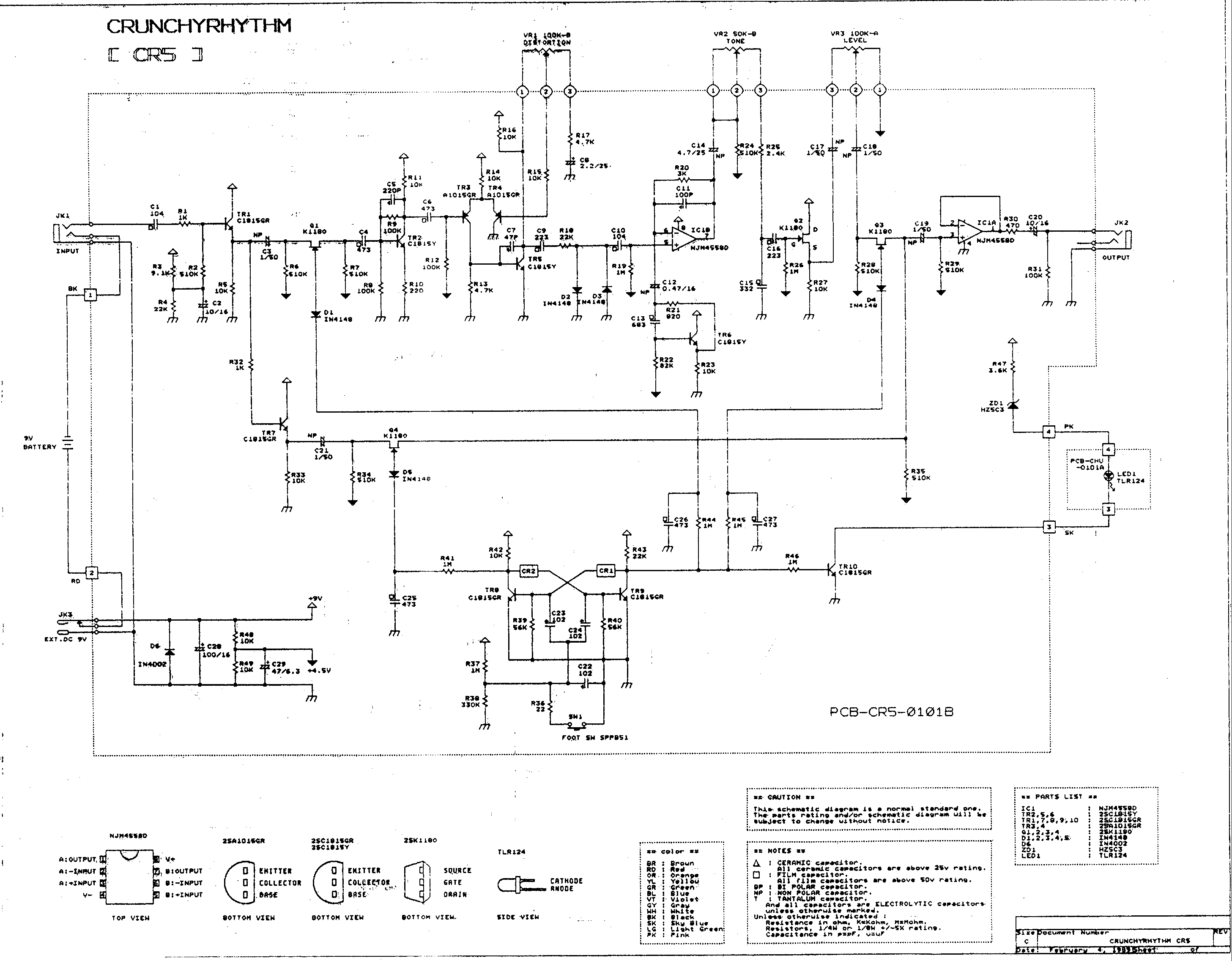
CrunchyRhythm CR-5

|
This one surprised me. So far, other than for the tubescreamer, I had never seen Maxon desigs leverage into the
Soundtanks (which are of non-Maxon design). In this case, for the drive stage there's an awful resemblance to the
DS-10 Distortion charger. Both seem to utilize some kind of discrete opamp as drive stage. Ofcourse after this the DS-10 has a different tonecontrol.
|
Thrashmetal TM-5

|
No description yet
|
Tube Screamer TS-5

|
What's more to say about a Tubescreamer that hasn't been said all over this page already. It's a Poor man's TS9 having the sound but not the looks. This doesn't mean that there's no potential in this one. All modifications that can be done on the various versions of the tubescreamer can be applied to the TS-5 as well, making it a cheap startoff to experiment with pedal midifications. |
Cyberdrive CD-5

|
Heavily misunderstood pedal. One of the best quotes I saw to illustrate this was in a Harmony Central review of this pedal is the "I cannot get a bluesy tone" remark..... Now, think about it
would you expect a bluesy tone from a pedal called "Cyberdrive"??? Come On! Get Real!
|
Echo Machine EM-5

|
Now, here's an interesting one.
|
Delay DL-5

|
No description yet |
Compressor CP-5

|
No description yet |
Chorus CS-5
|
|
No description yet. |
Auto Wah AW-5
|
|
The AW-5 Auto Wah uses the same bandpass filter that's also used in the black WH10's (single pot version) as well as for the tone control of the
CD-5 Cyberdrive. Compared to other, older, envelopefilters like the AF-9 and the AFL I have to admit I find the AW5 somewhat disappointing.
|
Black Noise BN-5

|
The BN5 seems to be a variation on the Powerlead as they share the same board layout and component numbering.
However, in the case of the BN, some stages are left out of the circuit.
|
Flanger FL-5
|
|
Did not exactly know what to expect of this flanger. Flangers aren't really my cup of tea anyway. While tracing the circuit of the FL-5 it came more and more
clear that it was an exact clone of the FL-9 with the FL-9's delay control omitted.
|
Bass Compressor BP-5
|
|
The bass brother of the CP5 compressor which is, circuitwise, identical to a CP10/CPL compresor which in turn is a MXR dynacomp type OTA comressor.
|
Tremolo TL-5

|
In the whole Ibanez/Maxon history very sometimes something shows up only once. While working with panning and other stereo amplitude modulation effects
earlier the TL-5 is the only dedicated tremolo ever sold by Ibanez. Similar to the OT10 octaver, the only octaver they ever did or the NB10, the only
noise supressor ever done (under the Ibanez Flag).
|
Phaser Phasetone PT-909

|
No description yet. |
Chorus CS-505

|
If it weren't for the required 18 volts supply power, the CS-505 would make me forget a CS-9 instantly! |
Flanger FL301-DX

|
No description yet. |
Compressor II CP-835

|
|
Tube Screamer TS-7C

|
Uhuh.
|
Delay/Echo DE7C

|
Landmark in digital delays. What a great delay this is! |
Smash Box SM7
|
|
No description yet |
Chorus Flanger CF7
|
|
Extremely similar to the Ibanez DSC10 from the power series, both with a Mitsubishi M50198 Delay line inside. Clean sounding chorus and definitely usable. Especially for the budget price these things are sold for. I don't believe in "warm" chorus sounds which I consider sales crap. However, if preferring the chorus sounds like John Scofield or Mike Stern, stay analog with a CS9 or the like. Those will give the crunch of the delay line distorting. I like that personally but beauty is in the ear of the beholder. |
Multi effect UE-400
|
|
Posted on the Ibanez Collectors world a while ago (by me)
|
Multi effect UE-405
|
|
No description yet. |
Multi effect UE-300
|
|
No description yet. |
Digital Delay DM500
|
|
No description yet. |
Phasetone PT-1000

|

|
Another one of those rarities. I have seen this one, marketed under another brand, on Ebay once and it went for far less money than the Ibanez brands. I should've bought it. I found this one on a local auction page, reported broken, for some 45 Euro's with the specific request not to bid, become the highest bidder, and then start bargaining to lower the price. One of the previous owners switched polarity on his power supply and destoyed all (3) OpAmps. Therefore the thing was fixed in a few minutes. However the lever of the side switch is broken off and I'm still trying to get a new one. Furthermore someone has drilled a hole in the front (partially through the label, for (I guess) the addition of an adapter socket. |
Phasetone II/707

|
This phasetone doesn't, circuitwise, compare to other pre TS-808 era Phasetone's. While those phasetones use FET transistors as variable resistors in the phasing circuit this one uses VTC type optocouplers. Although not the same it is very clear that parts of the design for this one have been borrowed from the MXR Phase100.
|
Flanger FL-303
|
|
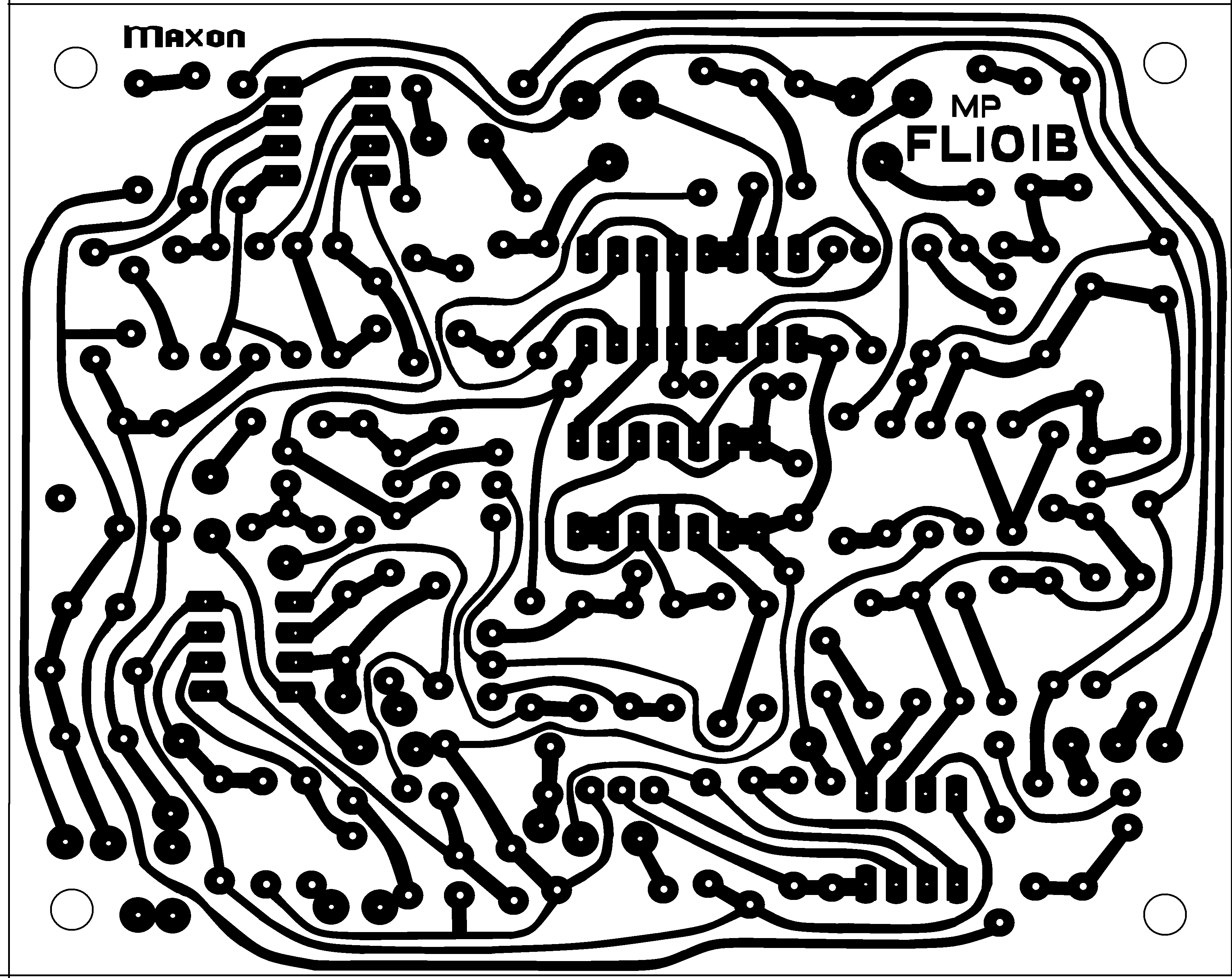
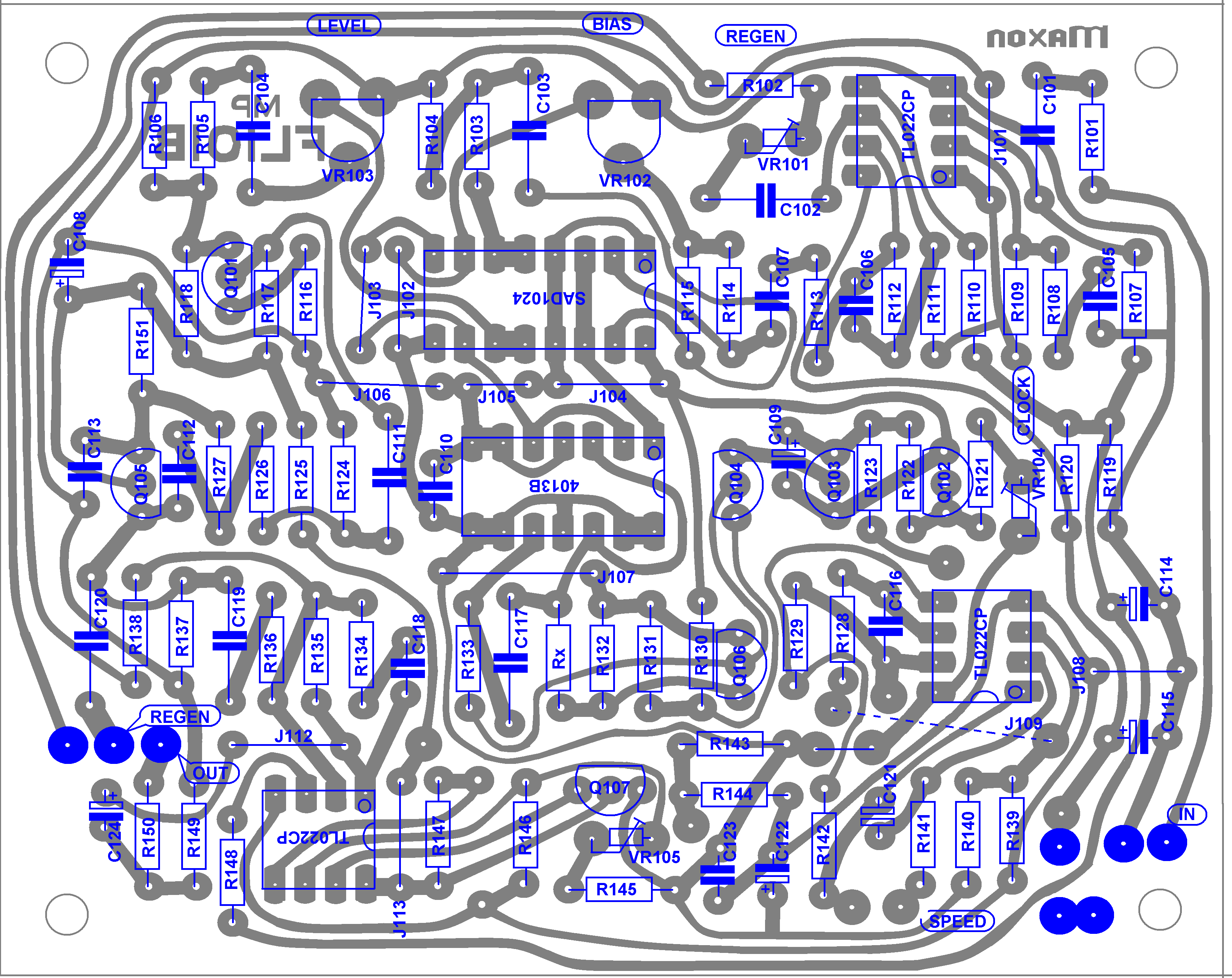
Nice SAD1024 based Flanger. This one was "upgraded" with a DC adapter input. I had to replace 2 opamps and a transistor because "adapter" sooner or later means "wrong polarity"
|
Standard WauWau

|
No description yet. |
Tube King Compressor TC-999

|
Schematic of the TC-999:
|
Analog Delay AD-99

|
Why re-invent the wheel? The AD-99 is,circuitwise and aside from the bypass, an almost dead on clone
of the classic AD9. And why not? Differences between the AD9, the ADL and the CD10 were already minimal, why change.
They're all good analog delays. Never change a winning team.
|
Classic Phase PH-99

|
Intereting thing this is... It's the first optical Phaser released by Ibanez since the PT707/PhasetoneII. Not that they have much resemblance.
|
Classic Flange FL-99

|
As close as the AD99 above is to all other Ibanez analog delays, so different is the FL99. First, different from the PH-99, the AD-99 and the RC-99, the FL99 does not have a compander to boost the signal to noise ratio.
Other than that the heart of the FL-99 is an MN3210 BBD chip. These are rare.. very rare. They're almost just as rare as the similar MN3010 that can be found in some ADA flangers. Hold it here for a second! There's no implication here that the 2 sound alike because of this. However,
the diode limiter at the input (schematic below) does suggest that the designers of this thing have taken at least a look at the ADA while making up this one. And there's little wrong in that.
|
Rotary Chorus RC-99

|
The RC99 chorus was about the first of the Ibanez Neo-Classic series of which I traced the circuit. Perhaps the TK999 was earlier. After that it was about the last from this series I obtained. The RC99 is a great chorus. One of the
best I know. Therefore it was interesting to see houw much it has in common with the simple SC10 chorus. Differences are that the RC-99 has a delay time
control whereas this is a fixed setting in the SC10. Other than that the RC99 has a compander (NE571 type) making it a litte quieter, The rest is fairly similar.
|
Tube King TK-999

|
Taking that starved plate design a step further. Although the tube amplifier stage is still connected as amplifier it isn't really doing amplification. The input signal is gained to extremes and then fed through the tubestage. This makes the tube act more like some kind of
filter with tube characteristics then as amplifier. Effective tone control following the distortion stages. This is the European version with a built in (but never used) noise reduction.This specific TK is heavily modified making the sound a lot tighter, lower on noise and more immune to power supply noises.
|
Graphic Equalizer GE-100

|
OK. You to add some kind of extra In or Out..... What's a more logic location to drill a hole than in the middle of the front panel? Unbelievable.... |
Graphic Equalizer GE-1000

|
The successor off the GE-100. With the "new" Ibanez logo. I was amazed how little info there is on the net for this model. No Harmony Central review (and for the GE-100 there's only one). Compared to the GE-100 there's absolutely no difference at all. They're identical form an electronics perspective. Still a bummer that the bypass switch isn't a footswitch. These EQ-s are pretty effective but not so easy to use on a pedal board. |
Tube King TK-999HT
|
|
Being a gearslut as I am I had to have this one. First of all to get to know the differences between the old one and this new thing and 2nd of all to get a picture if there's any resemblance
between old and new at all.
|